

Your Hosting Company May Be Hiding Your Business From ChatGPT
A growing number of companies are discovering that the AI assistants their customers now ask for recommendations cannot read their website at all. In most cases, nobody at the company made that decision.
What the published data shows
A study released in September 2026 by Suff Digital, which parsed the robots.txt files of 15.4 million websites using HTTP Archive data, found that 9.9% block at least one AI crawler by name. Among sites that serve a working robots.txt file, the share rises to 11.5%. Among the 1,000 most visited websites in the world, it reaches 28.9%.
GPTBot, OpenAI’s crawler, is the most frequently named: 8.7% of all sites block it, and 23.1% of the top 1,000. ClaudeBot follows at 8.3%, CCBot at 8.2% and Google-Extended at 7.6%.
Those are deliberate choices. A line in robots.txt is written by somebody. The more consequential number is the one no study measures.
The block nobody counts
A robots.txt file is a published request. A security layer is a closed door, and it leaves no public record.
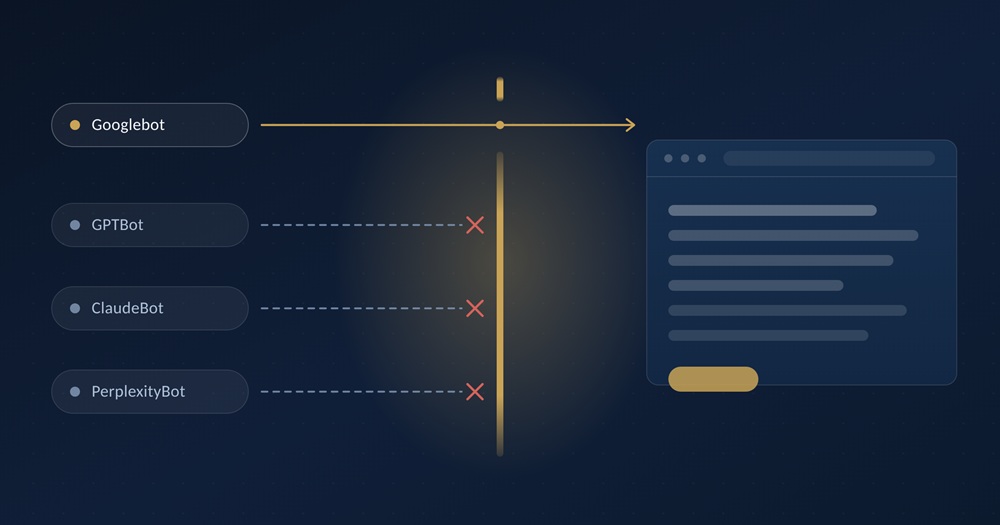
Most hosting providers run some form of bot protection, whether a web application firewall, a challenge page or a rate limiter, to stop automated traffic from consuming server resources. These systems classify visitors by behaviour and reputation, and many of them do not recognise the newer AI crawlers. When that happens, the crawler receives a verification screen or a server error instead of the page. The site owner sees nothing: analytics record no visit, robots.txt still says everything is permitted, and Googlebot, which almost every protection system recognises, passes through normally.
SEO Soluciones España, a digital marketing agency based in Alicante, Spain, found exactly that pattern on its own website in September 2026 during an internal audit. Google Search Console reported roughly 9,400 crawl requests over three months, a 95% success rate and no problems at host level. When the same pages were requested by clients identifying themselves as GPTBot, ClaudeBot, PerplexityBot and Bingbot, every request returned either a holding page reading “One moment, please…” or a 503 server error. The site’s robots.txt file explicitly allowed all of them.
The agency then confirmed the behaviour with the crawler itself. Asked to open a specific interior page and quote its opening paragraph, ChatGPT reported that its direct request had been stopped at a verification screen and that it could only reach the text through a search index. After the hosting provider added allow rules at its security layer, the same test returned the page’s live text.
Why providers do it
There is a defensible argument on the hosting side. AI crawlers fetch far more than they send back. Cloudflare Radar data for the third quarter of 2026 puts Anthropic’s crawl-to-referral ratio at 988 to 1 and Perplexity’s at 1,083 to 1, against 4.9 to 1 for Google. On a shared server, that is cost without return traffic.
The problem is not the decision but its scope. Protection is applied across an entire platform, the site owner is rarely informed, and the cost of being unreadable falls on the business, not on the host.
Why it matters now
Search results already answer more questions than they refer. AI Overviews appeared on roughly 48% of Google queries by March 2026 according to BrightEdge tracking, up from about 30% in December 2025. Seer Interactive, studying 25.1 million impressions, measured organic click-through rate on queries carrying an AI Overview falling from 1.76% to 0.61%. Pew Research Center, analysing 68,000 queries, found clicks dropping from 15% to 8% when an AI summary was present.
Visibility is shifting from ranking in a list to being named in an answer, the practice now known as generative engine optimisation. It depends on something more basic than content strategy: the assistant has to be able to open the page.
How to check in five minutes
Read your own robots.txt. Open yourdomain.com/robots.txt and look for Disallow lines naming GPTBot, OAI-SearchBot, ClaudeBot, PerplexityBot, Google-Extended or CCBot. If the file itself does not load, that is already a finding.
Ask an assistant to open a page. Choose an interior page, not the homepage, and ask ChatGPT or Perplexity to quote its first paragraph and state whether it reached the page directly or used search results. A quoted paragraph matching text you published recently means direct access works.
Ask your hosting provider a specific question. Not whether bot protection is active, but whether Googlebot, Bingbot, GPTBot, OAI-SearchBot, ChatGPT-User, PerplexityBot, ClaudeBot and Google-Extended are on the allow list, and whether robots.txt is served without a challenge. Many crawlers treat an error on that file as an instruction to stay away entirely.
Access is a floor, not a result
Being readable does not guarantee being recommended. AI systems weigh sources that are clearly structured, consistent about who and where a company is, and corroborated elsewhere on the web. None of that work pays off, though, for a site the assistant cannot open. Businesses spending on visibility would do well to confirm the door is open before furnishing the room.
About SEO Soluciones España
Founded in 2017 and based in the province of Alicante, SEO Soluciones España is a digital marketing agency working with companies across Spain and internationally. Its team covers search engine optimisation, AI search visibility, web design and digital advertising. The agency has been recognised at the Global Business Awards for four consecutive years.
